
Wait, why does this matter?
The stakes around adoption are high, and they're only getting higher. As markets become more competitive, development cycles more costly, and the expectations of users (whether they are patients, clinicians, consumers, or employees) more demanding than ever, the margin for getting adoption wrong is narrowing.
The cost of failure is also very real, with cautionary tales in abundance and the statistics to back them up. As we explored in Part 1, around 80% of new products fail within two to five years of launch – not in the first year, when iteration is still expected, but later, when adoption should be building and return on investment should be materialising. The average product takes years to develop and significant investment to bring to market. When adoption doesn't follow, that investment doesn't just stall – it erodes. Teams are pulled back into problem-solving mode, roadmaps get disrupted, and the confidence of stakeholders and investors takes a hit that can be difficult to recover from. In healthcare and medtech specifically, the consequences extend beyond the commercial: a solution that fails to be adopted is also a patient outcome that never improved, a clinical burden that wasn't relieved, a problem that remains unsolved.
The digital health sector offers a particularly stark example of what adoption failure looks like at scale. The wave of digital health investment that peaked in the early 2020s – reaching nearly $60 billion globally in 2021 – was followed by a significant correction, with funding falling by more than 75% to just $13 billion by 2023. Not because the underlying problems weren't real, or the technology wasn't capable, but because adoption consistently fell short of expectations. Clinicians didn't embed new tools into their workflows. Patients didn't sustain engagement. Health systems didn't integrate solutions in ways that made them viable long-term. The result was a sector-wide stalling of confidence and investment that is only now beginning to recover, as a new generation of products – built with a clearer understanding of what adoption actually needs – start to demonstrate what's possible.

http://rockhealth.com/insights/
But the case for designing deliberately for adoption isn't just about avoiding failure – it's about the lasting value that comes when you get it right. Products that are well adopted generate better real-world evidence, stronger user relationships, and more meaningful feedback loops that inform the next iteration. Organisations that embed adoption thinking into their development process build a capability that pays dividends across every product they bring to market. And teams that can point to sustained, measurable adoption are far better positioned – with investors, with procurement, with regulators, and with the users themselves.
Designing for adoption is, in the end, designing for the impact your product has on creating benefit in users lives, on improving their workflows, on creating better clinical outcomes. It’s ultimately the reason why you bother at all, and deserves to be seen as such.
How to design for adoption.
Designing for adoption isn't a single activity or a specific phase of development – it's a way of thinking that shapes decisions across the entire product journey. That said, there are some core principles that consistently underpin the approaches that work.
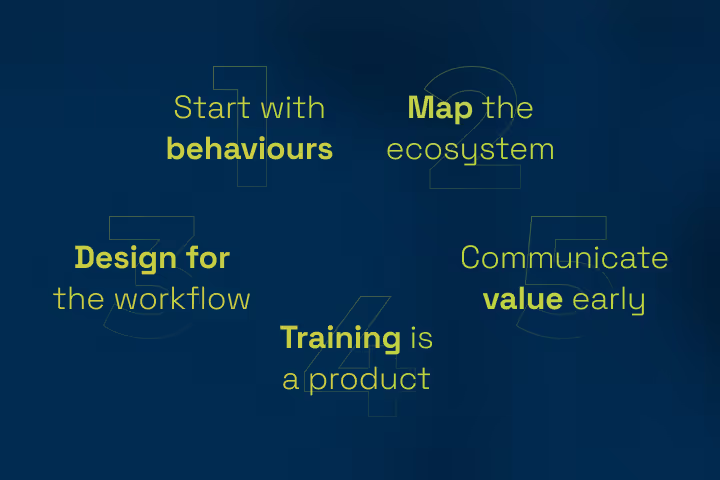
- Start with behaviours, NOT features. By far the most common mistake in product development is building around capabilities rather than the change you're trying to create. Understanding what needs to shift in how people work, make decisions, or manage their lives – and then designing to make that shift as easy as possible – is a fundamentally different starting point to feature-led development, and it produces fundamentally different (and better!) outcomes.
- Map the full stakeholder ecosystem. Adoption decisions are rarely made by a single person. The person using a product day-to-day, the manager who sanctioned it, the IT team that integrated it, the procurement lead who renewed it – each plays a role in whether a solution survives and scales. Designing for adoption means understanding that ecosystem and addressing the needs and motivations of everyone in it.
- Design for the workflow, not around it. Solutions that ask people to change how they work in order to accommodate the product will always face resistance. Solutions that slot into existing rhythms, complement established habits, and reduce friction rather than introduce it will always find adoption easier. This sounds obvious, but it requires a depth of workflow understanding that many teams simply don't invest in early enough.
- Treat training and onboarding as products in their own right. How people are introduced to a solution, and how they're supported through the early stages of use, has a huge impact on long-term adoption. Onboarding that is clear, contextual, and confidence-building doesn't just reduce drop-off and improve adherence – it sets the tone for the entire user relationship.
- Communicate your value clearly and early. Adoption curves are rarely linear – engagement can drop once the initial novelty wears off, and teams that aren't prepared for this often interpret it as failure when it's actually a predictable and designable-around moment. The antidote is making sure users feel the value of a solution clearly and early, before that dip has a chance to take hold. Building in re-engagement touchpoints and supporting users through the transition from novelty to habit are both ways to design through the dip rather than be derailed by it.
Know your adoption pathway.
While these core principles are a useful guide – and teams that apply them consistently will be better placed than most – principles alone don't build a fully realised adoption pathway. There is no quick fix, no shortcut, no prompt, that can make up for a poor or non-existent strategy for adoption. A checklist of good intentions is not the same as a deliberate, designed strategy for getting a solution from first encounter to sustained, embedded use.
The adoption pathway is where these principles become practice. It's the structure that holds everything together across the full arc of development – from the earliest research and co-design activities, through pilot and validation, to go to market and beyond. Without it, even teams doing many of the right things can find themselves with gaps they didn't see coming, at stages they weren't prepared for.
The good news is that adoption failure is often predictable and largely preventable. But only if you know where the gaps in your pathway are – and most teams don't have a clear picture of that until something goes wrong.
That's why we've built a short diagnostic to help. Six questions that will give you a clearer picture of where your adoption pathway is strong, and where it might be quietly working against you. It takes less than three minutes, and you'll come away with genuinely useful insights into how well you know your adoption pathway, and help you find the gaps early, before the market finds them for you.
————————————————
Questions about your adoption pathway? Concerns about how prepared you are or the risk of any unknown gaps?
Book a discovery call and let's start solving the problem together.